Symptoms
Shortness of Breath (Dyspnea)
The thickening of the lung interstitium impairs gas exchange, leading to hypoxemia, and reduces lung compliance, limiting the ability of the lungs to expand and increasing the work of breathing. Both of these factors can contribute to shortness of breath (dyspnea) in those with ILD. The dyspnea often begins during exertion, such as exercising or climbing stairs, but can become severe at rest as the disease progresses.
This image illustrates the interstitial thickening caused by fibrosis. For gas exchange in the lungs, gases (O₂ and CO₂) diffuse across the alveolar–capillary (blood–gas) barrier. This involves a very thin series of layers including the alveolar epithelial cell layer (type I pneumocytes), alveolar epithelial basement membrane, interstitial space, capillary basement membrane, and capillary endothelial cell layer. In ILD, the interstitial compartment and adjacent alveolar epithelial regions are most directly affected, becoming thickened due to inflammation and fibrosis. This increases the diffusion distance and reduces the rate of O₂ and CO₂ transfer across the barrier. According to Fick's Law, diffusion across a membrane is inversely proportional to its thickness. Therefore, as the alveolar–capillary barrier thickens in ILD, gas exchange becomes progressively impaired.
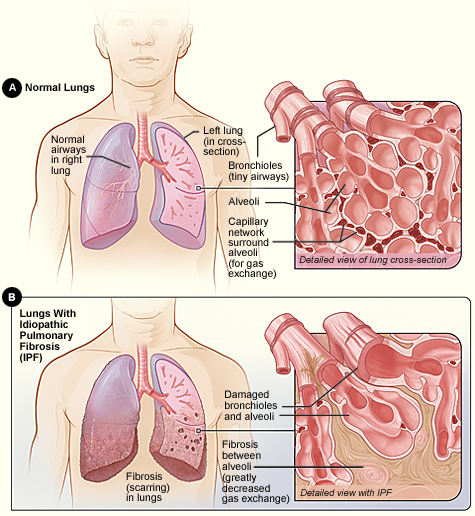
Image courtesy of National Heart Lung and Blood Institute (NIH)
Dry Cough
Hypersensitivity of the cough reflex is thought to be one prominent cause of the chronic cough that many patients with ILD face. This occurs due to inflammation and scaring-induced irritation of airway nerve endings. Due to this hypersensitivity, even simple things like talking, taking deep breaths, or laughing can act as cough triggers. Patients may also have co-morbid conditions that further predispose them to a cough, such as asthma, GERD, asthma, rhinitis, and obstructive sleep apnoea.
Constitutional Symptoms
Additional symptoms of ILD include extreme fatigue or weakness, unexplained weight loss, and loss of appetite. There are many proposed explanations for these symptoms, including the high energetic cost of breathing due to lung scarring, side effects of medications, psychological stress, and chronic inflammation.
Constitutional symptoms are most common in ILD diagnoses associated with Systemic Autoimmune Rheumatic Diseases (SARDs).
References
Althobiani, M. A., Russell, A. M., Jacob, J., Ranjan, Y., Folarin, A. A., Hurst, J. R., & Porter, J. C. (2024). Interstitial lung disease: a review of classification, etiology, epidemiology, clinical diagnosis, pharmacological and non-pharmacological treatment. Frontiers in medicine, 11, 1296890. https://doi.org/10.3389/fmed.2024.1296890
Štefániková, M., Sedláková, V., Portakal, T., Hampl, A., Vaňhara, P., & Doubková, M. (2025). Insight into the pathogenesis of interstitial lung diseases and near-to-native lung fibrosis models. European Journal of Medical Research, 30(1), 1232. https://doi.org/10.1186/s40001-025-03504-4
Wijsenbeek, M., & Cottin, V. (2020). Spectrum of Fibrotic Lung Diseases. The New England Journal of Medicine, 383(10), 958–968. https://doi.org/10.1056/NEJMra2005230